
Have you ever suffered a burn and wondered which cream could help it heal faster and prevent infection? You’re not alone. One name that often comes up is Quench Cream. But what exactly is it? Quench Cream is a topical antibacterial medication, with its key ingredient being Silver Sulfadiazine. It’s primarily used as a burn wound dressing to protect against infection and promote healing. This comprehensive guide will walk you through everything you need to know—from its core uses for burns and potential for scars, to the correct dosage, possible side effects, and its cost in places like Pakistan.
In this article, you will learn:
- What Quench Cream is and how its active ingredient, Silver Sulfadiazine, works.
- Its primary medical uses for burns and secondary uses for acne or rashes.
- The correct way to apply it and how long to use it for best results.
- A detailed list of potential side effects and important safety warnings.
- Its effectiveness on burn marks and scars compared to other creams.
- Updated price information for different sizes in Pakistan.
- Answers to the most common questions people ask online.
Try More Free Tools:
- Read our Nims Tablet Uses | Nims Tablet Side Effects | Dosage
- Read our Chia Seeds Urdu: Chia Seeds Benefits (Male+Female) [Dosage & Price]
- Read our Augmentin Tablet: – Price, Uses, Dosage, & Side Effects
Table Of Contents
What is Quench Cream? Understanding the Basics
Quench Cream
Quench Cream is a topical antibacterial medication containing silver sulfadiazine. It is primarily used to prevent and treat infections in burn wounds, promoting faster healing.
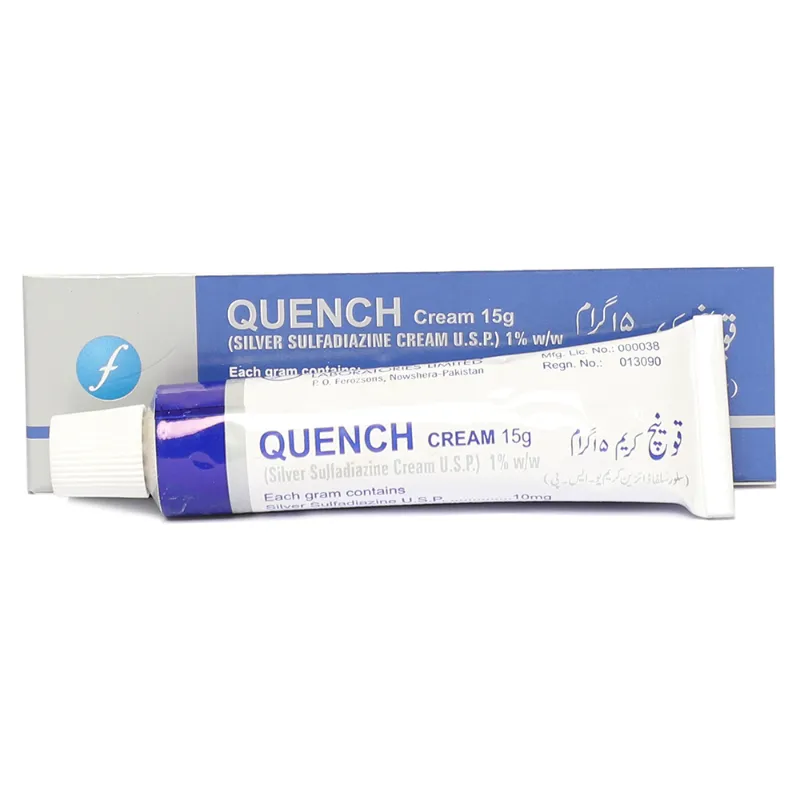
Let’s start with the fundamentals. Quench Cream is not a simple moisturizer. It is a topical antimicrobial cream, which means it’s a medicine you apply to your skin to fight germs. The powerhouse behind it is an ingredient called Silver Sulfadiazine. Think of it as a two-in-one fighter: the silver part damages the cell walls of bacteria and fungi, while the sulfadiazine part interferes with their ability to multiply. This combination makes it highly effective at preventing and treating infections in vulnerable skin, like burns.
You might find it under different brand names, such as Silverex Cream, but they all contain the same core ingredient. It’s commonly available in tubes, often in sizes like Quench Cream 15g for smaller areas or Quench Cream 50g for more extensive burns.
What is Quench Cream Used For? Primary and Common Uses
People get this cream for various reasons, but it’s crucial to know what it’s officially meant for and where it’s used with caution.
What does quench cream do?
Quench Cream creates a protective barrier over a wound. Its main job is to kill a broad range of bacteria and some fungi that can cause infection in raw, damaged skin. By preventing infection, it allows your body to focus on healing the underlying tissue.
Official Medical Uses: When Do Doctors Prescribe It?
The number one use, and the answer to “Which cream is best for burn skin?” in many medical settings, is for burn wound care. It is specifically designed for:
- Preventing infection in second and third-degree burns: These are serious burns that damage multiple layers of skin.
- Treating infected burn wounds: If a burn already shows signs of infection (like pus, increased redness, or fever).
- Managing other open wounds: Sometimes doctors recommend it for other types of skin ulcers or graft sites to keep them sterile.
Can We Use Quench Cream for Other Skin Issues?
This is where many questions arise. People often search for “Quench cream use for acne scars” or “Quench Cream use for rashes.” This is considered “off-label” use, meaning it’s not the primary purpose, but some people or doctors try it.
- For Acne and Pimples: Some explore it because of the antibacterial properties of silver, asking “Is silver sulfadiazine good for acne?” While it may dry out a pimple, it’s not a first-choice acne treatment. It can be overly drying and may stain the skin. Modern acne gels with benzoyl peroxide or salicylic acid are usually better options.
- For Rashes: It might be used for a rash only if a doctor suspects a bacterial infection complicating the rash. For most common, itchy rashes, it is not suitable.
- For Scars: The big question: “Is Quench cream good for burn marks?” Its role is in prevention, not treatment. By preventing infection during initial healing, it can reduce the severity of scarring. However, for old, already-formed scars, it is not an effective removal cream.
What Are the Benefits of Using Quench Cream?
Why choose this cream for a serious burn? The benefits are clear:
- Strong Infection Shield: It offers broad protection against many bacteria common in burn wounds.
- Moist Healing Environment: It keeps the wound bed suitably moist, which is proven to speed up the healing process (How to heal skin burns faster?).
- Pain Relief: By covering nerve endings, it can provide a soothing effect and reduce pain.
- Scar Prevention Aid: As mentioned, by promoting clean, infection-free healing, it sets the stage for less noticeable scarring.
Important Clarification: Some confuse it with a moisturizer called “Simple Skin Quench Gel Cream.” They are completely different. Quench (Silver Sulfadiazine) is a medicated antimicrobial, while the Simple product is a non-medicated hydrator. Does Quench cream help with wrinkles? No, it does not. It is not an anti-aging or moisturizing cream.
How to Use Quench Cream: A Step-by-Step Guide
Using it correctly is key to its effectiveness and safety. Let’s break down the Quench cream how to use process.
How to Use Quench Cream for a Burn?
Always clean your hands first. If possible, let a healthcare professional clean the burn initially.
- Clean the Wound Gently: Rinse the area with cool, clean water or a sterile saline solution. Pat dry with a clean, soft cloth.
- Apply a Thin Layer: Take a sterile glove or applicator and spread a very thin layer (about 1/16 of an inch thick) over the entire burned surface. You should still be able to see the skin/wound through the cream.
- Cover with a Dressing: The cream should always be covered with a sterile non-stick gauze pad or a specialized burn dressing. This keeps it in place and protects the area.
- Reapply Regularly: Here’s the answer to “How long should I leave burn cream on?” Typically, you leave it on for 24 hours. Then, gently wash off the old cream, check the wound, and apply a fresh layer with a new dressing. Your doctor will give you the exact schedule.
What is the Correct Dosage and Frequency?
- How many times a day can you use quench cream? The standard is once or twice daily, as directed by a doctor.
- How many times can I apply silverex? The same rule applies—usually 1-2 times per day.
- How long does silver sulfadiazine take to heal? Healing depends on the burn’s severity. Superficial burns may heal in weeks, while deeper ones take much longer. The cream is used until the wound is well on its way to healing or a doctor says to stop.
Special Considerations for Sensitive Areas
- Can I use silver sulfadiazine on my face? What cream is good for burns on the face? Yes, it can be used on facial burns, but with extra care. Avoid getting it in the eyes, mouth, or nose. Be aware it can cause temporary skin discoloration or staining on the face.
Potential Side Effects of Quench Cream: What You Must Know
Like all medicines, it can cause side effects. Knowing them helps you use it safely.
Common, Usually Mild Side Effects
These are often seen where the cream is applied:
- Burning or itching sensation (usually temporary).
- Skin discoloration (a brownish-gray tint that normally fades after stopping use).
- Mild skin rash or redness.
What Are Serious Side Effects?
While rare, stop using it and contact a doctor immediately if you notice:
- Signs of a severe allergic reaction: hives, intense itching, swelling of the face/lips/tongue, trouble breathing.
- New or worsening pain, redness, swelling, or pus (could indicate the infection is worsening).
- Unusual bleeding or bruising, sore throat, fever (possible blood cell effects).
How long do side effects last? Mild local effects like itching often go away as your skin adjusts. Discoloration may take weeks to fade after you stop the cream.
Critical Warnings: When NOT to Use This Cream
- When not to use silver sulfadiazine? If you are allergic to sulfa drugs or silver.
- If you are pregnant near your due date, breastfeeding, or have a premature newborn.
- On deep puncture wounds or severe chemical/electrical burns unless a doctor is managing care.
- When not to use burn cream? If the wound is already closed or scabbed over and simply dry or itchy.
Can Quench Cream Remove Burn Marks and Scars?
This is a major concern for anyone who has had a burn. Let’s set clear expectations.
Does Quench cream remove burn marks?
Not directly. Its primary contribution is during the initial healing phase. By preventing infection, it helps the wound heal as smoothly as possible, which can minimize the formation of severe, raised scars later on.
Which cream reduces burn marks?
For existing scars, different products are used:
- Silicone Gel Sheets or Gels: These are the gold standard for treating and flattening raised scars (hypertrophic or keloid scars).
- Prescription Creams: Doctors may prescribe stronger creams containing steroids or other ingredients.
- Sun Protection: Using a strong sunscreen (SPF 30+) on a healed burn is crucial to prevent the scar from darkening permanently.
How to fade a burn scar quickly?
True scar fading takes time and consistency, not speed. A combined approach works best:
- Protect from the sun every single day.
- Use silicone-based scar products as directed for several months.
- Massage the scar gently with a moisturizer to improve softness.
- Consult a dermatologist for professional treatments like laser therapy for stubborn discoloration (How to remove brown burn marks?).
Quench Cream Compared to Other Common Creams
It’s helpful to see how it stacks up against other products you might know.
| Feature | Quench Cream (Silver Sulfadiazine) | Polyfax / Neosporin (Bacitracin, Polymyxin) | Simple Skin Quench Gel |
|---|---|---|---|
| Type | Prescription-strength antimicrobial | Over-the-counter antibiotic ointment | Non-medicated moisturizer |
| Main Use | Prevent/Treat serious burn infections | Prevent infection in minor cuts, scrapes | Hydrate and soften normal skin |
| Key Question | Is burn cream an antibiotic? (Yes, antimicrobial) | Is mycitracin an antibiotic? (Yes) | Is it for wrinkles? (No, just hydration) |
| Best For | Severe burns, major wounds | Small everyday wounds | Dry skin, not for wounds |
What is the best healing cream for burns?
For serious burns, a doctor will likely recommend a silver-based cream like Quench/Silverex. For minor burns, a simple antibiotic ointment or a specialized hydrogel might suffice.
What is Polyfax cream used for?
Polyfax is typically used for minor skin infections, like infected cuts or impetigo, and is considered safe for small areas. It is not the first choice for large burns.
Quench Cream Price and Availability in Pakistan
Cost is a practical concern for many. Prices can vary based on pharmacy, city, and brand.
- Quench Cream 15g price in Pakistan: This smaller tube is typically used for limited areas. Prices can range from approximately PKR 200 to PKR 350.
- Quench Cream 50g price in Pakistan: The larger, more economical size for bigger wounds. Prices generally range from PKR 500 to PKR 800.
You can find it at most major pharmacies in cities like Quench cream available in Lahore, Karachi, and Islamabad. Quench Cream online purchasing is also possible through reputable pharmacy websites, but ensure you are buying from a trusted source.
Frequently Asked Questions (FAQs)
How does quench work?
It works by releasing silver and sulfadiazine ions that attack and kill bacteria on the surface of the wound, preventing them from causing an infection deep in the skin.
Can I apply polyfax on a burn?
For a very minor, superficial burn (small, red, no blisters), Polyfax can be an option. For any blistering or larger burn, it’s safer to consult a doctor who may prefer a silver-based cream.
Is silver good for pimples?
Silver has antibacterial properties, but it’s not a mainstream acne treatment. It can be drying and may stain skin. Stick to products designed for acne.
When to not use antibiotic ointment?
Avoid using any antibiotic cream, including Quench, on deep animal bites, deep puncture wounds, or serious injuries without seeing a doctor first. Also, don’t use it for long periods on minor cuts that are already healed.
Is antibiotic cream safe?
When used for short periods (a week or two) on specific wounds as directed, it is generally safe. Long-term, unnecessary use can lead to skin irritation or antibiotic resistance.

Add a Comment