Description
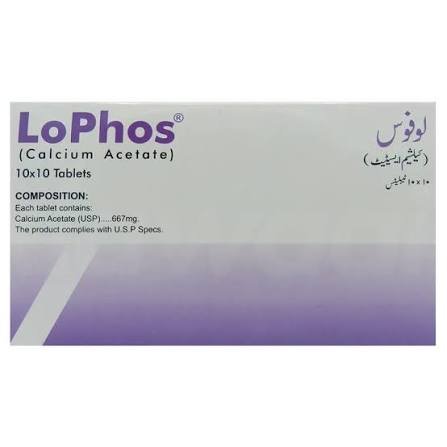
Lophos Tablets 667mg (1 Box = 10 Strips) (1 Strip = 10 Tablets)
Product Overview
Lophos Tablets 667mg (1 Box = 10 Strips) is a prescription phosphate binder containing the active ingredient Calcium Acetate. It is specifically used to control high blood phosphate levels (hyperphosphatemia) in patients with chronic kidney disease (CKD) , particularly those undergoing dialysis. Manufactured by a trusted pharmaceutical company, this medication works by binding dietary phosphorus in the gastrointestinal tract, preventing its absorption into the bloodstream. This allows the bound phosphorus to be excreted from the body through the stool, effectively lowering elevated serum phosphate levels. By controlling hyperphosphatemia, Lophos helps prevent serious complications associated with high phosphate levels, including bone disease, vascular calcification, and cardiovascular events. Each box contains 10 strips with 10 tablets per strip, providing a total of 100 tablets for convenient, ongoing treatment.
This prescription phosphate binder delivers effective control of hyperphosphatemia in CKD patients:
Binds Dietary Phosphorus: Works by binding phosphate from food in the digestive tract, preventing its absorption into the bloodstream.
Lowers Elevated Phosphate Levels: Effectively reduces and maintains healthy blood phosphate levels in patients with chronic kidney disease.
Supports Bone Health: Helps prevent renal osteodystrophy and other bone disorders associated with high phosphate levels.
Reduces Cardiovascular Risk: Helps prevent vascular calcification and reduces the risk of cardiovascular complications linked to hyperphosphatemia.
Dialysis Patient Care: Specifically indicated for patients with end-stage renal disease (ESRD) undergoing dialysis.
Convenient Tablet Form: Easy-to-swallow 667mg tablets for daily use.
Value Pack: Each box contains 10 strips with 10 tablets each (100 tablets total) for long-term treatment.
Prescription Medication: Requires a prescription from a qualified healthcare professional.
What are the Primary Uses and Key Features of Lophos Tablets 667mg?
Lophos Tablets 667mg serve as a specialized therapeutic solution for managing hyperphosphatemia in patients with chronic kidney disease. They are designed to address the underlying phosphate imbalance that can lead to serious health complications.
Core Uses of This Medication
Treatment of Hyperphosphatemia: The primary indication is for the control of elevated serum phosphate levels (hyperphosphatemia) in patients with chronic kidney disease.
Phosphate Binder in Dialysis Patients: Specifically indicated for patients with end-stage renal disease (ESRD) who are undergoing hemodialysis or peritoneal dialysis.
Prevention of Bone Disease: Helps prevent renal osteodystrophy and other metabolic bone disorders associated with high phosphate levels.
Reduction of Vascular Calcification: Helps reduce the risk of vascular calcification, which is a leading cause of cardiovascular complications in CKD patients.
Management of Mineral Metabolism: Supports the overall management of calcium and phosphate balance in patients with kidney disease.
Standout Product Features
| Feature | Description |
|---|---|
| Active Ingredient: Calcium Acetate 667mg | A phosphate binder that binds dietary phosphate in the gastrointestinal tract, reducing its absorption and lowering serum phosphate levels. |
| Effective Phosphate Control | Clinically proven to effectively reduce and maintain healthy blood phosphate levels in CKD patients. |
| Dialysis Patient Indication | Specifically formulated for patients with end-stage renal disease undergoing dialysis treatment. |
| Meal-Time Dosing | Must be taken with meals to bind dietary phosphate effectively. |
| Calcium Supplementation | Provides calcium supplementation as part of phosphate management therapy. |
| Prescription Medication | Available only with a prescription from a qualified healthcare professional. |
| Convenient Packaging | Each box contains 10 strips with 10 tablets each (100 tablets total) for convenient, long-term treatment. |
What Key Ingredients are in Lophos Tablets 667mg and What Do They Do?
The efficacy of Lophos Tablets 667mg arises from its active ingredient, Calcium Acetate, which acts as a phosphate binder in the gastrointestinal tract.
Comprehensive Breakdown with Benefits
| Component | Primary Role & Health Benefits |
|---|---|
| Calcium Acetate 667mg | The active pharmaceutical ingredient. A phosphate binder that works by binding dietary phosphate in the gastrointestinal tract. The calcium ions react with phosphate to form insoluble calcium phosphate, which is not absorbed into the bloodstream and is excreted in the feces. This effectively lowers serum phosphate levels and helps maintain healthy mineral metabolism in CKD patients. |
| Tablet Excipients | Inactive ingredients that form the tablet matrix, including fillers, binders, and disintegrants. These ensure the tablet remains stable, dissolves properly, and delivers the active ingredient effectively. |
How Should I Use Lophos Tablets 667mg Correctly?
For maximum efficacy and safety, follow these directions for use as prescribed by your healthcare professional.
Best Practices for Consumption
Follow Prescription Instructions: Always take Lophos Tablets exactly as prescribed by your doctor. Do not change your dose or stop taking the medication without consulting your healthcare provider.
Dosage: The dosage is individualized based on your serum phosphate levels. Your doctor will determine the appropriate dose for you.
Take with Meals: CRITICAL: Lophos must be taken with or immediately after meals to bind the dietary phosphate consumed. Taking it without food is ineffective.
Swallow Whole: Swallow the tablet whole with a full glass of water. Do not crush, chew, or break the tablet.
Consistency: Take the medication consistently with each meal to maintain effective phosphate control throughout the day.
Missed Dose: If you miss a dose, take it with your next meal. Do not take a double dose to make up for a missed one.
Regular Monitoring: Your doctor will regularly monitor your serum phosphate, calcium, and PTH levels to adjust your dose as needed.
Discontinuation: Do not stop taking the medication without consulting your doctor. Phosphate levels may rise rapidly if treatment is discontinued.
Important Considerations
Prescription Only: This medication is available only with a prescription from a qualified healthcare professional.
Regular Blood Tests: Regular monitoring of serum phosphate, calcium, and parathyroid hormone (PTH) levels is essential.
Dietary Compliance: Phosphate binders work best when combined with a low-phosphate diet. Follow your dietitian’s recommendations.
Calcium Levels: This medication contains calcium. Your doctor will monitor your serum calcium levels to prevent hypercalcemia.
What Precautions Should I Be Aware of Before Taking This Medication?
While generally safe and well-tolerated, specific conditions and interactions require awareness and caution.
Key Warnings and Contraindications
Allergic Reactions: DO NOT USE if you are allergic to Calcium Acetate or any of the other ingredients in this medication. Seek immediate medical attention if you experience signs of an allergic reaction (rash, itching, swelling, severe dizziness, difficulty breathing).
Hypercalcemia: DO NOT USE if you have high blood calcium levels (hypercalcemia). This medication contains calcium and may worsen hypercalcemia.
Calcium Supplementation: If you are taking calcium supplements or vitamin D supplements, inform your doctor. You may need to adjust your intake.
Digoxin and Cardiac Glycosides: Use with caution in patients taking digoxin or other cardiac glycosides. Hypercalcemia may increase the risk of cardiac arrhythmias in these patients.
Sarcoidosis: Use with caution in patients with sarcoidosis, as they may be at increased risk of hypercalcemia.
Medication Interactions: Calcium Acetate may interact with certain medications, including:
Tetracycline and Quinolone Antibiotics: Calcium can reduce the absorption of these antibiotics. Take at least 2 hours apart.
Levothyroxine (Thyroid Medication): Calcium can reduce the absorption of thyroid medication. Take at least 4 hours apart.
Bisphosphonates (Osteoporosis Medications): Calcium can reduce absorption. Take at least 2 hours apart.
Iron Supplements: Calcium can reduce iron absorption. Take at least 2 hours apart.
Pregnancy and Breastfeeding: Inform your doctor if you are pregnant, planning to become pregnant, or breastfeeding. Use only if clearly needed and prescribed by your doctor.
Medical Conditions Requiring Consultation
Hypercalcemia: Inform your doctor if you have a history of high blood calcium levels.
Cardiac Disease: Inform your doctor if you have any heart conditions or are taking digoxin.
Parathyroid Disorders: Inform your doctor if you have any parathyroid gland disorders.
Kidney Disease: Your doctor will monitor your kidney function and adjust your treatment as needed.
Diabetes: Inform your doctor if you have diabetes.
Are There Any Potential Side Effects of Lophos Tablets 667mg?
As with all medications, Lophos Tablets may cause side effects, although not everyone experiences them. Most side effects are mild and transient.
Commonly Reported Side Effects
| Reaction | Description |
|---|---|
| Hypercalcemia (High Calcium Levels) | Elevated blood calcium levels may occur. Regular monitoring by your doctor is essential. |
| Constipation | The most common side effect. Increasing fluid intake and dietary fiber may help. |
| Nausea | Some patients may experience mild nausea. |
| Vomiting | Mild vomiting may occur in some patients. |
| Diarrhea | Some patients may experience diarrhea. |
| Flatulence (Gas) | Increased gas or bloating may occur. |
| Abdominal Pain | Mild stomach discomfort or cramping may occur. |
Serious Side Effects (Seek Medical Attention Immediately)
Severe Allergic Reaction: Difficulty breathing, swelling of the face/lips/tongue/throat, severe dizziness, or extensive rash.
Severe Hypercalcemia: Symptoms may include confusion, fatigue, nausea, vomiting, bone pain, or irregular heartbeat.
Severe Constipation: Persistent, severe constipation that does not resolve.
Signs of Intestinal Obstruction: Severe abdominal pain, bloating, vomiting, or inability to pass stool.
When to Discontinue Use and Seek Medical Help
Discontinue use immediately and seek medical attention if you experience:
Severe Allergic Reaction: Difficulty breathing, swelling of the face/lips/tongue/throat, severe dizziness, or extensive rash.
Symptoms of Hypercalcemia: Severe nausea, vomiting, confusion, bone pain, or irregular heartbeat.
Severe Constipation or Abdominal Pain: Persistent or worsening constipation or severe abdominal pain.
How Should I Store This Medication to Maintain Potency?
Proper storage is essential for maintaining the stability, efficacy, and safety of Lophos Tablets.
Optimal Storage Conditions
Temperature Control: Store in a cool, dry place at room temperature (below 30°C/86°F). Protect from light and moisture.
Keep in Original Packaging: Keep the tablets in their original blister strip packaging until ready to use.
Keep Out of Reach: Store in a location that is out of reach and sight of children and pets.
Check Expiry Date: Do not use the medication after the expiry date printed on the packaging.
Disposal: Do not dispose of medications in wastewater or household waste. Ask your pharmacist how to dispose of unused or expired medications.
Who Manufactures Lophos Tablets 667mg?
Lophos Tablets 667mg are manufactured by a reputable pharmaceutical company committed to quality, safety, and innovation in healthcare. The medication is produced in state-of-the-art facilities following strict Good Manufacturing Practices (GMP) and quality control standards.
Commitment to Quality and Safety
GMP Compliance: Manufactured in facilities that follow strict Good Manufacturing Practices.
Quality Assurance: Each batch undergoes rigorous quality testing to ensure purity, potency, and consistency.
Regulatory Approval: Approved by national and international regulatory authorities for safety and efficacy.
Patient Safety: A commitment to providing safe, effective, and high-quality medications.
How Does This Phosphate Binder Compare to Other Options?
Understanding the distinct advantages of Lophos Tablets 667mg helps in making an informed treatment decision.
Lophos (Calcium Acetate) vs. Key Alternatives
| Feature | Lophos (Calcium Acetate) 667mg | Calcium Carbonate Phosphate Binders | Non-Calcium Phosphate Binders | Sevelamer-Based Binders |
|---|---|---|---|---|
| Active Ingredient | Calcium Acetate —a calcium-based phosphate binder. | Calcium Carbonate. | Aluminum-based, Lanthanum-based. | Sevelamer Hydrochloride/Carbonate. |
| Mechanism of Action | Binds dietary phosphate in the gut by forming insoluble calcium phosphate. | Binds dietary phosphate in the gut. | Binds phosphate through various mechanisms. | Binds phosphate through ion exchange. |
| Calcium Content | Provides calcium —approximately 169mg of calcium per 667mg tablet. | Provides calcium. | No calcium content. | No calcium content. |
| Best For | Patients who need phosphate control plus calcium supplementation. | Patients needing phosphate control with calcium supplementation. | Patients at risk of hypercalcemia. | Patients at risk of hypercalcemia or with gastrointestinal issues. |
| Common Side Effects | Constipation, nausea, hypercalcemia. | Constipation, nausea, hypercalcemia. | GI upset, potential aluminum toxicity (older binders). | GI upset, nausea, constipation. |
| Dosing Frequency | Usually with meals. | Usually with meals. | Varies. | Varies. |
Frequently Asked Questions (FAQs)
1. What is Lophos Tablets 667mg used for?
Lophos Tablets 667mg are used to control high blood phosphate levels (hyperphosphatemia) in patients with chronic kidney disease (CKD), particularly those undergoing dialysis.
2. How does Lophos work?
Lophos contains Calcium Acetate, which binds to dietary phosphate in the gastrointestinal tract, forming an insoluble compound that is not absorbed and is excreted in the stool.
3. How should I take Lophos Tablets?
Lophos must be taken with or immediately after meals to bind the phosphate from the food you eat. Swallow the tablet whole with a full glass of water.
4. Why is it important to take Lophos with meals?
Taking Lophos with meals is critical because it needs to bind to the phosphate in the food you just consumed. Without food, the medication is ineffective.
5. What are the common side effects?
Common side effects include constipation, nausea, vomiting, diarrhea, gas, and abdominal pain. The most common side effect is constipation.
6. Can Lophos cause high calcium levels?
Yes. Because Lophos contains calcium, it can raise blood calcium levels (hypercalcemia). Your doctor will monitor your calcium levels regularly.
7. Can I take Lophos with other medications?
Inform your doctor about all medications you are taking. Calcium Acetate may interact with certain drugs, including tetracycline antibiotics, quinolone antibiotics, levothyroxine, bisphosphonates, and iron supplements. Take these medications at least 2-4 hours apart.
8. Is Lophos safe during pregnancy?
Use during pregnancy only if clearly needed. Inform your doctor if you are pregnant, planning to become pregnant, or breastfeeding.
9. What should I do if I miss a dose?
If you miss a dose, take it with your next meal. Do not take a double dose to make up for a missed one.
10. How should I store Lophos Tablets?
Store in a cool, dry place at room temperature (below 30°C/86°F). Protect from light and moisture. Keep out of reach of children.
11. Is Lophos Tablets available over the counter?
No. Lophos Tablets are a prescription medication and are available only with a prescription from a qualified healthcare professional.
12. How many tablets are in each box?
Each box contains 10 strips with 10 tablets per strip, providing a total of 100 tablets for convenient, long-term treatment.